

Ukrainian strikes deep into Russian territory are no longer symbolic: they impact military logistics, aviation, air defence, production, and change the message that the Kremlin so often manipulates - the sense of security in Russia. Ukraine is systematically shifting the war into Russian rear areas. ( Read more in our analysis How Ukraine Is Turning Russia's Distance Into Vulnerability)
Let's closely examine the course of these strikes from the beginning of 2026 until May 9, the day the proposed ceasefire between Russia and Ukraine began (Putin, through US mediation, proposed a ceasefire, which Trump announced along with a POW exchange, Ukraine later confirmed the ceasefire).
In January 2026,
Ukraine ramped up strikes on Russian energy, logistics and fuel facilities, signalling a systematic long-range campaign to complicate Russia's rear operations and raise costs for Moscow. Strikes pushed Russia to redirect resources in order to defend rear infrastructure, disperse air defences, and secure energy and logistics sites away from the front.
In February 2026,
Ukraine's strikes reached deeper into Russian territory (800-1700 km) and hit more types of targets. The main focus was on energy infrastructure, but Kyiv also begins regular strikes on defence industry targets producing parts for weapons, strikes became more regular and were targeted to a wider area.
In March 2026,
Ukraine's focus shifted to Russia's war economy: oil refineries, pipelines, ports on the Black Sea and in the Baltic, and chemical plants. Strikes are less isolated and more like a systematic campaign that affects the stability of production cycles, export routes and logistics in Russia's energy sector.
In April-May 2026,
Ukraine turned the deep-strikes campaign on a main level -multi-layered pressure on Russia's critical infrastructure. Energy, defence industry and logistics systems are struck simultaneously - instead of one-time damage, repeated strikes prevent recovery and create ongoing disruption.
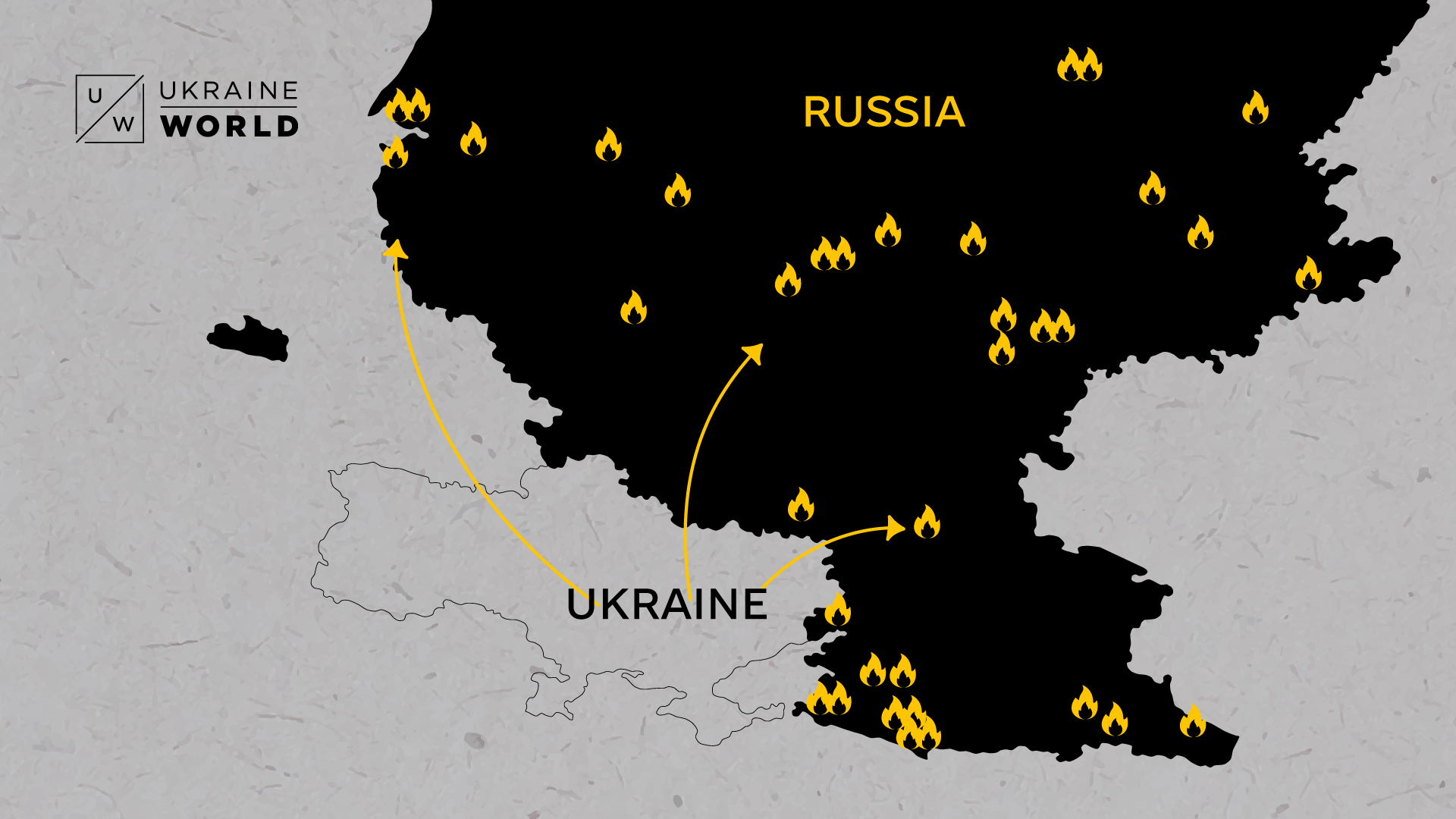
The list below illustrates how Ukraine systematically expanded its long-range campaign across Russian territory. Distances are approximate and may refer to either straight-line distance or the publicly cited strike range estimated by Ukrainian officials.
April 2
Location: Ufa, Republic of Bashkortostan, Russia
Distance from Ukraine: ~1,300-1,500 km
Target: Bashneft-Novoil oil refinery (Rosneft)
April 4
Location: Tolyatti, Samara Oblast, Russia
Distance from Ukraine: ~750-1,000 km
Target: KuibyshevAzot chemical plant + Tolyattikauchuk petrochemical plant (simultaneous strike on two facilities)
April 5
Location: Kstovo, Nizhny Novgorod Oblast, Russia
Distance from Ukraine: ~800 km
Target: Lukoil-Nizhegorodnefteorgsintez oil refinery
Location: Primorsk, Leningrad Oblast, Russia
Distance from Ukraine: ~900-1,000 km
Target: Oil pipeline infrastructure near Primorsk Baltic export terminal
April 6
Location: Novorossiysk, Krasnodar Krai, Russia
Distance from Ukraine: ~300-600 km
Target: Sheskharis oil terminal (Transneft)
Location: Rossosh, Voronezh Oblast, Russia
Distance from Ukraine: ~50-130 km
Target: Minudobreniya chemical plant (ammonium nitrate, nitric acid, ammonia production.
April 7
Location: Ust-Luga, Leningrad Oblast, Russia
Distance from Ukraine: ~1,000 km
Target: Transneft-Baltika oil export terminal - storage tanks and port infrastructure.
April 10
Location: Volgograd-Tikhoretsk pipeline corridor, Volgograd Oblast, Russia
Distance from Ukraine: ~600-650 km
Target: Main oil product pipeline - diesel artery to southern Russia and Black Sea region
Location: Kazan, Republic of Tatarstan, Russia
Distance from Ukraine: ~1,100-1,200 km
Target: Industrial / military-linked infrastructure
April 11
Location: Krymskaya pumping station, Krasnodar Krai, Russia
Distance from Ukraine: ~600 km
Target: Chernomortransneft oil pumping station (Tikhoretsk-Novorossiysk pipeline routes I-III)
April 15
Location: Sterlitamak, Republic of Bashkortostan, Russia
Distance from Ukraine: ~1,300-1,500 km
Target: Sterlitamak Petrochemical Plant (aviation fuel, jet fuel additives, synthetic rubber production)
April 16
Location: Tuapse, Krasnodar Krai, Russia (Strike 1 of 4)
Distance from Ukraine: ~350-500 km
Officially cited range: ~1,500 km
Target: Tuapse Oil Refinery + marine terminal (Rosneft)
April 17-18
Location: Novokuybyshevsk + Syzran, Samara Oblast, Russia
Distance from Ukraine: ~1,000-1,100 km
Target: Novokuybyshevsk oil refinery + Syzran oil refinery (both Rosneft) - simultaneous strikes
Location: Tikhoretsk district, Krasnodar Krai, Russia
Distance from Ukraine: ~550 km
Target: Tikhoretsk oil pumping station (Transneft pipeline node)
April 19
Location: Taganrog, Rostov Oblast, Russia
Distance from Ukraine: ~220-250 km
Target: Atlant Aero UAV production plant - Molniya strike drones, Orion UAV components
April 20
Location: Tuapse, Krasnodar Krai, Russia (Strike 2 of 4)
Distance from Ukraine: ~350-500 km
Officially cited range: ~1,500 km
Target: Tuapse Oil Refinery + port infrastructure (Rosneft)
April 23
Location: Kstovo district, Nizhny Novgorod Oblast, Russia
Distance from Ukraine: ~800 km
Target: Gorky oil pumping station (Transneft-Verkhnyaya Volga pipeline system)
Location: Novokuybyshevsk, Samara Oblast, Russia
Distance from Ukraine: ~1,000-1,100 km
Target: Novokuybyshevsk Petrochemical Company - MTBE production unit, fuel additives (Rosneft)
April 25
Location: Shagol airfield, Chelyabinsk Oblast, Russia
Distance from Ukraine: ~1,600-1,700 km
Target: probable damage 2× Su-57 stealth fighters + 1× Su-34 strike aircraft + 1 unidentified aircraft
April 26
Location: Yaroslavl, Yaroslavl Oblast, Russia
Distance from Ukraine: ~900-1,000 km
Target: Slavneft-YANOS oil refinery (~15 million tons/year processing capacity)
Location: Cherepovets, Vologda Oblast, Russia
Distance from Ukraine: ~1,000-1,100 km
Target: Apatit chemical plant (PhosAgro Group) - Ammonia-3 nitrogen complex, high-pressure sulfuric acid pipeline
April 28
Location: Tuapse, Krasnodar Krai, Russia (Strike 3 of 4)
Distance from Ukraine: ~350-500 km
Officially cited range: ~1500 km
Target: Tuapse Oil Refinery (Rosneft)
April 29
Location: Orsk, Orenburg Oblast, Russia
Distance from Ukraine: ~1,300-1,500 km
Target: Orsknefteorgsintez oil refinery - one of Russia's largest
April 30
Location: Perm, Perm Krai, Russia
Distance from Ukraine: ~1,500-1,600 km
Target: Lukoil-Permnefteorgsintez oil refinery (AVT-4 primary distillation unit) + Perm LPDS (Transneft pipeline dispatch station)
Location: Dzerzhinsk, Nizhny Novgorod Oblast, Russia
Distance from Ukraine: ~750-800 km
Target: Sverdlov Explosives Plant - a state defence enterprise producing artillery shells and industrial explosives
May 1
Location: Tuapse, Krasnodar Krai, Russia (Strike 4 of 4)
Distance from Ukraine: ~350-500 km
Officially cited range: ~1,500 km
Target: Tuapse Oil Refinery + marine terminal (Rosneft)
May 3
Location: Primorsk port, Leningrad Oblast, Russia
Distance from Ukraine: ~900-1,000 km
Target: Port, which is Russia's largest Baltic oil export hub, damaging a tanker and the infrastructure of the port.
Location: Novorossiysk, Krasnodar Krai, Russia
Distance from Ukraine: ~300-600 km
Target: Oil Infrastructure: two shadow fleet oil tankers (near port entrance, Black Sea)
May 5
Location: Cheboksary, Chuvash Republic, Russia
Distance from Ukraine: ~1,200 km
Target: VNIIR-Progress defence electronics plant (navigation and guidance system components for missiles and UAVs)
Location: Kirishi, Leningrad Oblast, Russia
Distance from Ukraine: ~1,000-1,100 km
Target: KINEF oil refinery (Kirishinefteorgsintez - over 20 million tons/year, Russia's largest by capacity)
May 7
Location: Perm, Perm Krai, Russia
Distance from Ukraine: ~1,500-1,600 km
Target: Lukoil-Permnefteorgsintez oil refinery + Perm LPDS (Transneft)
Location: Naro-Fominsk, Moscow Oblast, Russia
Distance from Ukraine: ~500-550 km
Target: Nara military logistics complex (Russian Ministry of Defence supply base)
Location: Kaspiysk, Republic of Dagestan, Russia (Caspian Sea)
Distance from Ukraine: ~1,200-1,600 km
Target: Project 22800 Karakurt-class missile corvette (Kalibr cruise missile-capable) at naval base
May 8
Location: Grozny + Znamenskoye, Chechnya, Russia
Distance from Ukraine: ~1,300-1,400 km
Target: Khankala military base area (42nd Motor Rifle Division HQ) + FSB building (Znamenskoye)
As global oil prices surged amid escalating tensions in the Middle East, Russia was expected to benefit from increased export revenues.
However, Ukraine's repeated attacks on key oil infrastructure disrupted operations at major export hubs. Attacks on terminals in Ust-Luga, Primorsk and Novorossiysk may have cost Russia about $2.2 billion
in lost revenue due to shutdowns and reduced exports, says Borys Dodonov of the Kyiv School of Economics. Also, recent refinery strikes are likely to worsen losses, with significant damage to Rosneft's Tuapse refinery requiring extensive reconstruction at a cost of up to $5 billion
, according to The Washington Post.
As of March 25, at least 40% of Russia's oil export capacity is halted due to Ukrainian drone attacks, Reuters reports based on market data.
The key effects of Ukraine's long-range campaign in spring 2026 (which are still unfolding) do not mean temporary destruction, but also indicate the cumulative depletion of Russia's war machine, which directly affects the Kremlin's ability to wage war and to maintain stable supplies of fuel and ammunition.
With significantly fewer resources, Ukraine forces Russia to consider where to use its air defence systems and divert resources to protect its rear infrastructure.
Ukraine shows the world that Russia's monopoly on long-range strike capability can be broken, this way fundamentally changing the balance of power on the battlefield.
This publication was compiled with the support of the International Renaissance Foundation. It's content is the exclusive responsibility of the authors and does not necessarily reflect the views of the International Renaissance Foundation.


