

Ivan Petriv, call sign "Hutsul," was a Ukrainian serviceman of the 93rd Separate Mechanized Brigade "Kholodnyi Yar," who was killed while carrying out a combat mission on June 28, 2025, near Andriivka in the Bakhmut district of Donetsk Oblast. In this interview, we speak with his wife, Mariia Petriv, about their 22 years together, Ivan's decision to voluntarily join the military, and the memorial she created on her own while still waiting for the possibility of a proper burial.
"My husband, Ivan Petriv, was born in the mountain village of Shepit in the Prykarpattia region. There were seven children in his family, and he was the youngest. At the age of six, he lost his mother — she died from a serious illness. He grew up under the care of his sisters and brothers, without knowing a mother's tenderness, yet he became an honest, hardworking, skilled man. He always wanted to achieve everything with his own hands.
After school, he was drafted into the army, but was initially rejected because of his orphan status. He came back and insisted himself: he wanted to serve because at that time it was considered honorable for a man. After the army, he worked in woodworking — carving Easter eggs, creating carvings for churches, making whatever people asked him to make. As they say, he had golden hands.
Soon we met, dated for a while, and then he proposed to me. I liked him very much — handsome, with open dark eyes, a sincere smile, and dimples on his face. I became deeply attached to him with all my soul. We were married for 22 years.
We had two daughters. Our eldest, Mariia, and then, 11 years later, Yevfrosyniia was born. He sensed that we would have another girl. Ivan adored our children. It always warmed my heart to watch him spend time with them because a father's love is something special, especially for daughters. He gave them his soul and his heart."
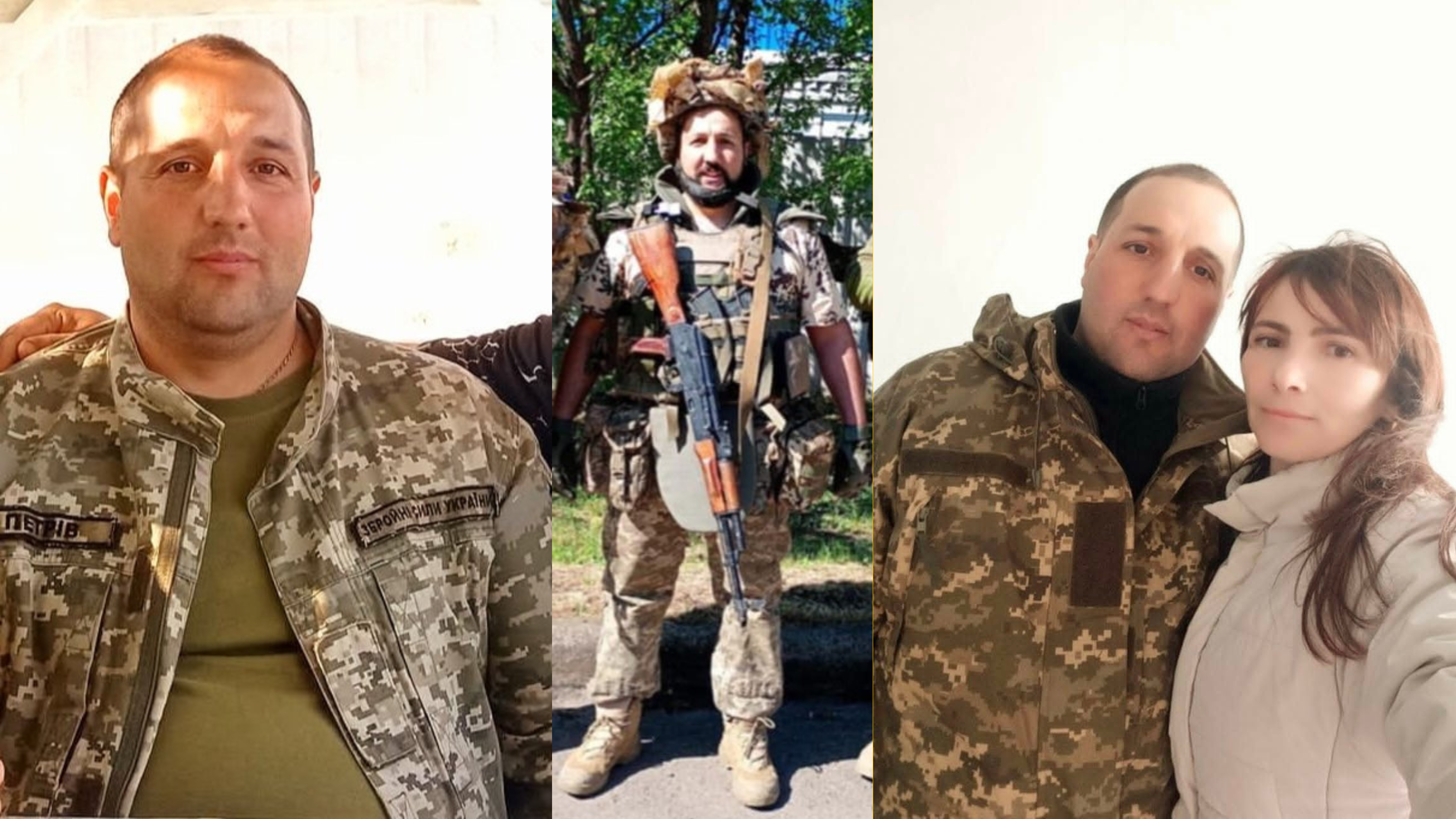
"In 2022, the Russians brought the full-scale war to Ukraine. On March 5, Ivan voluntarily joined the army. He said it was every man's duty. At first, he served not far from home and had the opportunity to see us often. I think God gave the girls that time so they could still feel their father's love. While he was serving near his place of residence, he had many health problems. He suffered from varicose veins and underwent surgery for a spinal hernia, but despite this, he never complained and continued to serve with dignity.
After some time, he was redeployed. From Prykarpattia, he was first sent to the Kharkiv Oblast, and later to the Donetsk Oblast, to Druzhkivka, where they were preparing for combat missions.
There were times when our younger daughter, Yevfrosyniia, would turn off the camera during video calls with her daddy. When I asked why, she answered: "Mom, I don't want Daddy to see that my eyes are crying." She didn't want him to worry. During war, children grow up too quickly.
The training ended, and before being sent to the positions, my husband called us. It was June 6, in the morning, around ten o'clock. My daughter and I were in the kitchen. He said: "Mariika, the political officer is calling me, I'll come back and call you again." I remember his eyes that morning — an unusual look, both brave and sorrowful at the same time. I had never seen such eyes in him before.
It was very painful for me because I knew where my husband was going. That there was war there. That there was grief, blood, explosions, that life ended there. I was in despair; my soul was torn apart. I went into town on errands because I could not stay at home. I went to church, and suddenly my husband, at my request, called right before departure. I always tried to take screenshots and record videos of our calls because I had a premonition that I would never see or hear him again. But I couldn't record that conversation because I was crying so hard.
He looked at me and told me not to worry, that he would return in a month. My heart sensed something terrible, but my mind could not believe that something like this could happen to me.
Several of his brothers-in-arms went to the position with him.He left his belongings and both of his mobile phones at the base. Later they told me that he carefully folded his washed clothes and packed his bags neatly.”
"After that, I could communicate with my husband only through radio transmissions. My daughters and I recorded a voice message, and the soldiers transmitted it to my husband over the radio. Two hours later, a reply came. I was in the kitchen drinking tea. I turned it on and heard his voice. It seemed to me that he hadn't even had any water to drink — his voice sounded so different. He said everything was fine, that we had to stay strong, that he would return. It was a short conversation, but so precious.
He recorded one more voice message right before he was wounded. Our older daughter also joined in our message. He replied: "Dear wife, my dear children... Everything is fine with me, I'm alive and healthy. Take care of yourselves there. I hug you tightly. I love you very much. I wish you all the best." When I heard that, I instantly felt that I would never hear him again. And that's exactly what happened.
A few days later, I was informed that Ivan had stepped on a petal mine: "Your husband is wounded." It was an indescribable shock for me. I called the soldiers from my husband's brigade and begged them to evacuate him. "There's no rain," they answered me. Drones wage war now. It is sinful to ask God for rain, but I begged Him for rain so that my husband could be evacuated. I hoped God would protect my husband because God protects orphans.
On the morning of June 28, it finally began to rain lightly. Ivan, together with his brothers-in-arms who came to help him — Vasyl and Roman — started leaving the position. He could move only on one leg: the other, after the petal mine and a week without proper medical assistance, was already unusable; gangrene could have developed. In addition, he had a wounded arm and probably injuries all over his body.
They did not get far — every meter there comes at a terrible cost. Russian soldiers spotted them. They started attacking with drones. The brigade command called me: "Ivan was evacuated, but during the evacuation a drone struck, and they all died." I locked myself inside the house. I did not go out. I held back my tears so no one would hear me. My husband was 43.
I asked the command to fly a drone and film it because I wanted to see my husband. Even though footage of positions is a military secret, they made an exception for me. Five days after his death, they sent me the video.
I saw with my own eyes where my Ivan lay. Around him — flies, worms. It is very painful. But I am grateful that I know the truth — bitter truth is better than eternal uncertainty.
In one of the Russian Telegram channels, I found a video from my husband's evacuation. I saw Ivan still alive: he was still crawling, still fighting, still wanting to live. One of his brothers-in-arms was hit directly in the head by a drone. Ivan was beside him. After the explosion, one of his legs was burned down to the bone, and his whole body was struck by shrapnel. I watched that video the entire night. I felt unbearable grief and, at the same time, joy because I was able to see my beloved husband one last time."
"After his death, my husband received the status of missing in action: at present, it is impossible to recover his body because active combat operations are ongoing there. Whether there will be an exchange is unknown.
I understand that the chances are very small. But there is still a tiny fraction of hope — that they will bring back at least his remains, his bones. So that I can bury him. He deserves that. He does not deserve such a death or such oblivion.
When they returned his belongings to me — his clothes, military gear — I searched through every pocket. I thought maybe he had left a note for me or for the children. There was nothing. Only things — and no person. Among the things that were returned to me was the T-shirt he slept in for the last time. I decided not to wash it. I keep this T-shirt because it still carries my husband's scent. Sometimes I breathe it in to feel that he is still close to me. This T-shirt is very special to me."
"Soon it will be a year since Ivan died. In his memory, I decided to install a memorial stele in our village. I wanted to have a place where I could come, pray, and lay flowers. I did not want him to be forgotten.
The path toward this turned out to be difficult: permits, approvals, communication with the village council and administrations. I did everything at my own expense. I succeeded. Now I go there every day. I light a candle. I pray. I feel calmer because there is a place where I can be close to him.

Despite the grief, I try to continue living. With all the strength I have and do not have. I came to the conclusion that on my own I can still control my body, my thoughts, and my emotions. I do not rely on medication. One simply has to live with this pain. You just get used to it. But there is emptiness everywhere. Wherever you go, everything feels empty. It is hard to look at the children because I see my husband's features in their faces. I grieve and rejoice at the same time. My husband is no longer here, but he will live in my memory, and I will continue preserving his memory through my actions.
I want him to be proud of me and to know that I will become stronger and that I will always remember him and never allow anyone else to forget him. He was the best husband, the best daddy. He was a hero of his country.
My husband went to defend not only our family but all of us, our glorious blooming Ukraine, which God created so that people could rejoice, live, and grieve within it.
We all must remember thanks to whom we live, wake up, and see the sunrise and sunset. We must value the sacrifice of our soldiers, defend all our human rights, and always remember that we are Ukrainians. Remember how many lives have already been lost and how many more will be lost."
"Since Ivan passed away, I have been writing poems about him. At night, when I cannot sleep, lines come to me. I live inside those poems.
As if just yesterday I lived within your arms — Today I fly with only one wing. I cannot grasp why I'm a widow now. In a single word — a chapter closed. — an excerpt from a poem —
I remember every detail: how he played with the girls, how he told Yevfrosyniia that the secret of delicious food is to make everything with love. How, for the last time, he walked around the house in the snow, and his footprints did not melt for a long time. I walked around looking at those little footprints.
After my husband's death, his brothers-in-arms called me: "Your Ivan was cheerful and friendly. You could talk with him and laugh with him. We still cannot believe it, but we remember him and always will."
He fulfilled his duty. He did not hide. He died for all of us, for our Ukrainian land. And I must become even stronger — for the sake of his memory, for the sake of our daughters, so that people like him are never forgotten.”
Heroes, as they say, do not die; they simply stop walking beside us, but they will always remain with us. The human body dies, but the soul is eternal and alive."


